Showing posts with label Burgundians. Show all posts

Tuesday, October 14, 2014

Mexican Cazadores, Burgundian Crossbowmen and Scottish Trollbloodz, oh my...


Mexican Cazadores:  Finally a match for my son's Tennessee Riflemen

 
Finally competed my Mexican Cazadores.  These are actually Perry's Carlist Wars British Riflemen.  As luck might have it, Santa Anna had been importing weapons, accoutrements, and equipment from England for years (and I think these molds are far better than Old Glory's Alamo series).

Santa Maria!
I hope los piratas Americanas never see the backs of these Cazadores...


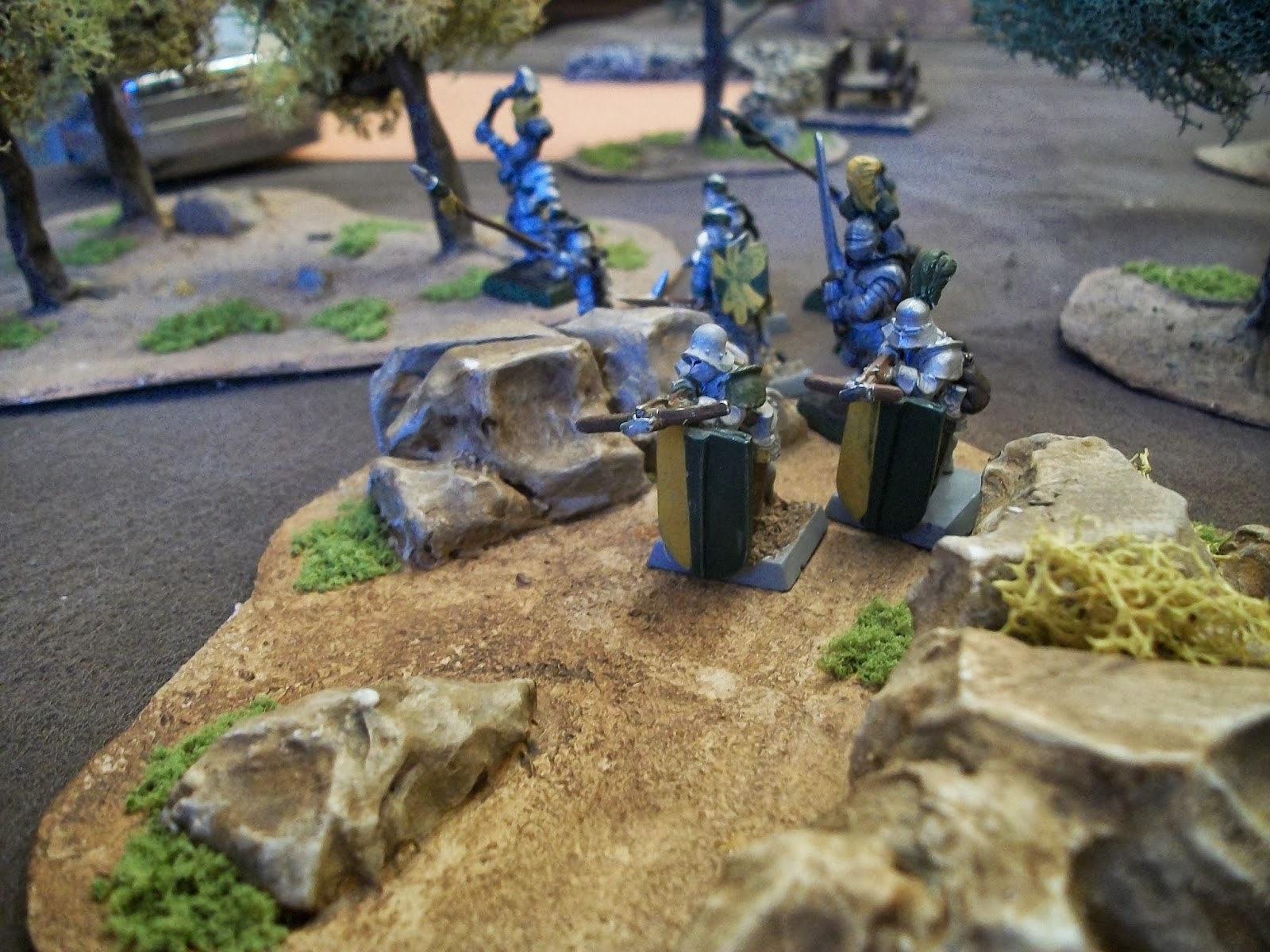
On the bench are the last of a box of Perry Plastics European Mercenaries.  These will be Burgundian Crossbowmen.  You'll note that I had to make new sleeves from Milliput on several of these guys as the sleeves I had left over didn't match the torsos.  I'm not sure whether I'm going to pick up another box and make a Swiss infantry army or start making my own Renaissance-era artillery. 


Burgundians awaiting bases.

Picked up a copy of Medieval Warfare this month (all about Charles the Bold and how the Burundian Wars tied to the Wars of the Roses and the many invasions of France by England). It's actually a back-issue from earlier in the summer... might have to start subscribing to this one.


 Charles had the most advanced horse artillery in Europe (second half of the 1400's) and it comprised a significant portion of his field armies.  Sadly, he wasn't much for assessing risk, cutting his losses, or determining critical vulnerabilities to exploit.  It seems he was an excellent administrator, an impetuous knight, but not a great tactician.

Swordsmen and lumbering brutes from Clan McHaggus.


Also on the bench are Trollbloodz Swordsmen and brutes.  The game (Hordes/Warmachine) is by Privateer Press which is a competitor of the Warhammer/40K line.  I don't often do fantasy wargaming, but when I do, it's because my sons want to play it.  What is a father to do?  In any event, these are nice models-both plastics and lead (if prohibitively expensive) and I did a lot of modeling to create a little diversity.  Gave one a pole for a standard (I'm thinking light blue with white bones in a St. Andrew's Cross), added hair to most, new helmets, tam-o-shanters (with left-over feathers from the Burgundians) , replaced the hammer with a cudgel and spike for the unit leader, and added tartan plaids and brooches on all.  The game appears to be played with cards and dice, so against my better judgment here I go... another unfinished army.

Sunday, August 17, 2014

Fog of War at 15th c Calais: A 28mm Battle Report


French soldiers attempt to repel a Burgundian landing on the Flemish coast.
Would you believe that the one thing my son wanted to do today was play out a wargame scenario?  The angels of odd shaped dice are singing.

Flemish and English mercenaries in the service of the Duke of Burgundy sail
towards Calais.
 The scenario was a Burgundian landing at a farm near Calais.  For the terrain, I had my new French Farmhouse, some fields and cut out felt to have four separate waterways.  Victory for the Flemings and English called for holding on to the farmhouse for ten turns, until additional troops can land to bring Calais under the influence of the duchy of Charles the Bold.  For the French, they must hold the farm for five turns until reinforcements arrive by sea.  A roll on a d8 would determine from where in the estuary the French cog would sail.  Then the French would have to capture the Burgundian caravel for victory. 

Flemish gunners wade onto the beach.
      The caravel pulled in sail as the fog on the coast of Calais parted to reveal a beach and a French farm.  Visibility war poor only a ten or twenty yards at most.  As my Flemings landed, they took their first shots at French malice advancing through the fields.  Sadly I rolled poor troop quality.  True to form, my son's rolls determined that his French were battle-hardened veterans.

French malice rush to occupy the farm house and barn.
       The heavy infantry moved quickly, supported by a few archers.  As I had to climb a hill, they were able to seize the houses first.

Unfortunately, the trees mask the French from the English bowmen.
 My English archers and Burgundian infantry remained aboard in support.  The trees masked the fire of the archers, however, and I would be forced to send reenforcements to my beleaguered gunners.  Rule #1:  Never send light infantry against heavy infantry.

Flemish gunners take the high ground...
My gunners did manage to take high ground that allowed them to support what would become and abortive attack on the barn.  They were assaulted by heavy infantry and archers.  Since I had a low troop quality roll (Green troops) there was no chance they could hold the hill against veteran heavy infantry.


The Flemings are charged before they can reload...

While my Flemings managed to drop a few men-at-arms, their guns do take time to reload...and that's why I should have disembarked pikemen and halberdiers.


...and the hill is carried by the heavier French infantry.
Things were not going well on the other side of the barn either.  The French had decent armor and were able to push through the Flemish fire.  A lucky French arrow felled my musician and captain, causing the gunners to fail a morale role and fall back to the caravel.  I disembarked part of my Burgundian halberdiers under a Sergeant.  Rule #2:  Never reinforce failure.

The lightly armed Flemish gunners cannot stand against the French
Heavy Infantry.
 The French infantry cheer madly, but not because the gunners are falling back to the protection of halberds.  The fog has parted and it is turn 5. Which means...

The Fog parts to reveal a French Cog on the caravel's port bow.
To late to make sail, the English must repel boarders.
A French cog is visible through the mist.  Of course my son rolled a 6 on d8.  That was the closest channel from which to sail towards my caravel!  Why wouldn't he roll that?  My English sailors won't even have time to sets the sails, let alone cut the anchor cable.

The caravel is forced up onto the beach.
 The cog runs right alongside the caravel, ramming and pushing it up on the beach.  There will be no escape unless the English and Burgundians can take the French cog...but no, my son has the high roll for initiative and boards me rather than being boarded himself.

Pinned by the French cog, the English archers must fight to the seaward.
 The archers turn to focus on the cog, at least the militia are far enough away that it will take two tuns for them to get to the beached caravel.  With some lucky rolls, my archers downed several crossbowmen on the fo'csle, but none of the French knights.

French knights and sergeants take the forepeak of the caravel
 and work back along the waist.
 Nevertheless the French Knights grapple and successfully board.  They make quick work of the lightly armed archers and wade into to the halberdiers over decks awash with blood.


The advance across the caravel's deck is supported by Italian crossbowmen
and French archers.

 My remaining halberdiers and gunners scramble up the chains and onto the caravel's decks, but they are no match for the French knights.  My remaining Burgundian knight is overwhelmed and hacked to pieces at the ladder to the poop deck.  With no leadership or promise of pay, the remaining English and Flemish mercenaries beg for mercy from the French knights.  As they are not nobles and won't command a hefty ransom, so they are not likely to receive it (mercy, that is).

The English and Flemings beg for mercy.
 Calais, though surrounded by Burgundian lands, remains in the hands of the Valois-through some mighty lucky dice rolls-I might add. Charles the Bold has learned that you can't take Calais on the cheap and demonstrates to his son some time-proven maxims.

Monday, December 2, 2013

Cog Wars: A short naval battle off the Flemish coast


Opening action.  The Burgundian Caravel is fast and maneuverable, but the
French Cog carries more men.  I need to keep my distance and pick them off one by one.

        Its the day after Thanksgiving and my son had finally finished painting his cog that he won at Historicon this past summer.  My caravel has been finished for a while, with the exception of the sails and rigging.  We kept it simple with square sails and a spanker for my caravel.  The sails are just linen scraps from a hunting shirt project (18th c AWI) that I whipped together on the machine and made fast to the booms and yards with some hemp cord.  Easy day.

      The engagement opened with the two vessels on opposite ends of the estuary amid some islands and rocks.  This would give us something interesting to maneuver around and, perhaps, run aground upon (1d4 roll if within 2 in. of shoals).   The rules we used were some house rules I whipped up in consultation with my resident 11 year old French knight. 
The Caravel  comes about to rake the fo'csle of the French Cog.
      The initial turn was all maneuvering around a central island, although lucky French arrow dispatched my lone musician.   This is important, since musicians impact a unit's coordination and help in ungraqppling during fighting.  The caravel's two swivels (large shot gun) were not accurate beyond 10 in, but as my agile caravel came about, it was able to pepper the French fo'csle twice in the space of two turns.  My decision to take hand gunners rather than archers was not good for a ship that relies upon long distance firepower and led to the demise of many men aboard my ship.  The handgunners, while lethal at close range, required me to allow the French cog to maneuver to closely.  This restricted my ability to maneuver to bring my swivels to bear and brought on the boarding below.  While, my maneuvering allowed me to dispatch all of the heavily armored Genoese crossbowmen on the French Cog, I was taking a beating from the French archers and did not have the men to spare on such a small ship, especially if I ran out of searoom and the Cog forced a boarding action, before I could thin his ranks.

The French grapple onto the caravel.
        Pinned against the "edge of the world", my mainsail became fouled (1d4 roll) and then the French grappled on to add insult to injury.   My hangunners and a well-timed close range blast from the port swivel gun (1d6+2 roll for all figures within the teardrop template, hits scored for a roll of 4-6, kills for all armor saves not resulting in 9,10 on 1d10) made quick work of the initial assault.


The gunners wipe out the first wave of French boarders.

 Only a knight and halberdier stood left of the original eight in the boarding party.  Unfortunately these were reinforced and crossed onto my aft deck, which was quickly a shambles with the remains of a knight, sergeant, and several halberdiers. 


Repel boarders!
        Despite the swivels and handgunners, the Burgundians were outnumbered and no match for heavily armored French men-at-arms.  After the second French boarding only four handgunners, sailors, and a man-at-arms remained.  After a valiant counter attack by the man-at-arms and the handgunners in the ship's waist, the French were pushed back onto the cog and the caravel wisely ungrappeled and sailed away.


Disengagement is the better part of valor.


       Within one turn I was well on my way out of range of the French archers.  Due to the wind direction and the ponderous handling of the cog, the French were unable to come about to give chase to the Burgundians.


The French watch as the faster and more maneuverable caravel
flees with the wind.
          While my caravel escaped, the French were clearly the victors.  They had killed a two knights and taken an infantry standard, though their losses were heavy, they could still fight their ship.  The Burgundians, on the other hand, would be sailing back to their den and licking their wounds.  It was a fun game, although we realized several changes needed to be made in the house rules.  Knights are too strong, virtually unkillable, unless by another knight.  We needed some additional rules for ship damage, the effects of grounding, and cannon-fire on hulls and rigging.  I also didn't bring my petardiers in the fighting tops into play...updated rules to follow accordingly!  I will also remember to leave the halberdiers at home for this ship and embark archers with which to pelt my son's ship at longer ranges.

Monday, October 14, 2013

Rainy Day 28mm Raid on Bouches-du-Rhone

Burgundian privateers wade ashore to strike a Provencal village.
           A rainy Sunday afternoon and my son asked to play a game.  He's been painting medieval-era 28mm since Historicon this summer.  So I set up a scenario and wrote some quick-play rules.  The scenario is set in the 1400s.  A Burgundian kogge sails into the Rhone estuary and anchors close to shore near the village of Bouches-du-Rhone in the region of Provence.  The Burgundians consist of the kogge, a section of mercenary English longbowmen, Burgundian handgunners, and infantry, led by a knight and two sergeants.

           The Burgundians must come ashore, destroy the crops and buildings and return to the ship.  The townspeople, armed with bows, must hold off the raiders until reinforcements from a local noble arrive.  My quick-play rules (written down in 10 minutes) were as follows:

          Since one of my son's objectives was to destroy more than 2/3 of the raid force, I left one sergeant, some sailors, and two longbowmen in the kogge to cover my retreat.  That worked out well, in the end.

The townsmen are alerted to the raiders' advance and move to the rooftops.

Archers and handgunners cover the infantry advance and destroy
the village fields.

The townsmen wreak havoc on the English mercenaries, 
but the fields are destroyed, nonetheless.

The Provencal forces of the Baron du Bouches arrive in the village 
to push back the raiders.
The handgunners are engaged and routed by the Provencal left wing.
With my archers destroyed, the Burgundian infantry take cover behind the 
stone walls.

The Burgundians hold against the Provencal charge, with the help of the wall.  
The Provencal right wing is routed, but the Burgundians fall back to the kogge.

A foot-race to cut off the fleeing raiders.

The Provencal soldiers arrive before their heavy infantry counterparts and
a melee develops on the strand.  The longbowmen come in handy, evening
the odds and leaving a few corpses in the surf.
The Burgundians force the Provencals into the surf and reembark.  
All the surviving raidersfrom the fight on the beach make it on board, except...

...my knight, who, with an unluckily poor armor save roll, is killed by a 
 Genoese crossbow bolt.

The Genoese crossbowmen advance with the knights and add insult to injury.

     So in the end, I scored 10 pts for the destruction of the fields.  Although I killed all the archers in one building, the Provencal infantry arrived before I could torch it.  My son was able to destroy my handgunner unit: 10 pts and kill my knight: 10 pts.  A fun game that took about ninety minutes to play eight turns.  In retrospect, the longbows were too powerful, so I changed them to the 1d6 to hit you see here.  Additionally its darn near impossible to defeat infantry behind a stone wall...but then, that's realistic.  All in all a good afternoon.

Saturday, August 31, 2013

Green Wargaming on a Budget: Making Trees from Repurposed Junk

Burgundian handgunners take cover in the treeline.
      When you're a kid, table-top gaming can be cost prohibitive...let's face it.  As an adult its still cost prohibitive.  Spending $20-40 dollars to get a pack of ten dubious-looking railroad scenic trees is something I don't really want to do.  Rather spend my doubloons on lead.  Thankfully, trees are an easy project with some time, household junk, and a few bucks from the local craft store.

You will need:

Cardboard
Coathangers
Painters or masking tape
Sand
Pebbles
Paints
White glue
Superglue
Floral Moss (1 bag is $5)
Blue insulation foam (4x8 sheet is about $16 at a DIY store)


Bases are ready for priming and sanding.
      To start:  Cut your bases and about thirty lengths of coathangers.  Sections of 3-8 inches are good for our scales.  Bind dissimilar wire lengths together with tape, leaving two inches exposed at each end.  The exposed areas will be your branches and roots.  Bend the branches and roots in various directions to achieve a natural look and tape down to the cardboard base.  Now you can sculpt that blue foam into rocks or other terrain features (knolls) under or around your tree.

Primed and ready for painting,
 Cover the base with white school glue and sand.  Add in pebbles or other debris as desired.  The whole must be painted.  I have a 5 gal bucket of nasty oyster latex I found in the basement of my house when I bought it.  Two years later, I'm still using it as a primer for my trees, buildings, and other terrain.

With a base coat, highlights and an ink wash, the trees are ready for foliage.
       Once primed, you can add your base colors, highlights, and inking.  I use acrylic paints from a craft store.  I get similar results to more pricey modelling paints and on this amount of area, thrift is a must.  I used a dark brown for the tree, clay color for the earth.  these were touched up with grey and dry brushed with a flesh base color (light khaki).  The whole was ink-washed with a mixture of brown and black.

Moss on the branches, coarse turf on the ground.
       For adding the foliage, a dab on small amounts of superglue and then thread the moss onto the branches.  Hold the moss in place as the glue dries.  If you use the glue sparingly, the moss will hold, but your fingers won't.

The last piece of moss.
       The moss is on and I will complete the forest floor with white glue and coarse turf (ground up foam).

The Burgundian infantry emerge from the completed "budget"  forest.

The completed forest.  The trees are based in groups of one, two, or three.  Three evenings of work, while watching baseball makes me a forest of fourteen trees.  Easy day-and I still have enough materials to make 140, should the scenario require.  In any event, I think these look a lot more realistic than whats on the market.  

Saturday, August 24, 2013

Historicon: Bargain Basement Longbowmen, or how to improve on horrible Bretonnian models.

 
English Longbowmen in Burgundian livery

    My brother passed away a few months ago, unexpectedly and his wife gave my son all his minis.  Mostly old Gamesworkshop Bretonnians from when we were kids.  I had sold all mine, but since my son won Most Valuable Gamer at Historicon Cog Wars (and consequently an Old Glory Cog)...we are delving back into late medieval gaming.  On to the Bargain basement and the vendors!  I picked up about thirty of the old plastic Bretonnian archers (two poses) and a box of Perry Bros. European Infantry.

Notice the hoods made of blue/yellow modelling putty.
       I dislike the Gamesworkshop figures in general because they are so chunky, but 30 figs for $3.50...not complaining.  I hacked off the heads and replaced with various heads from Perry, Games Workshop Empire (Mordheim) Militia, and Hammer of the Gods.  Adding a few recycled swords and such from my bits box, as well as modelling some hoods out of blue/yellow putty makes them seem less like Bretonnians.

A little work with a knife, pin vise, leftover parts, and putty...
      I am painting these as English Archers in the service of Charles the Bold.  Most Burgundian troops were crossbowmen and hand gunners, but the English did support Charles against his European foes (the enemy of my enemy...).
Finished hoods add variety to the once bland Bretonnians.
Matte sealer by Testors and flocking finish them off.  By the way, I've started using small wooden disks from the craft store for my bases.  I get about 50 for $3.00...a lot better that the plastic bases or laser cut bases on the market!  Just need to put the flags on my Burgundian Infantry (hand gunners, halberdiers) and the army is complete.